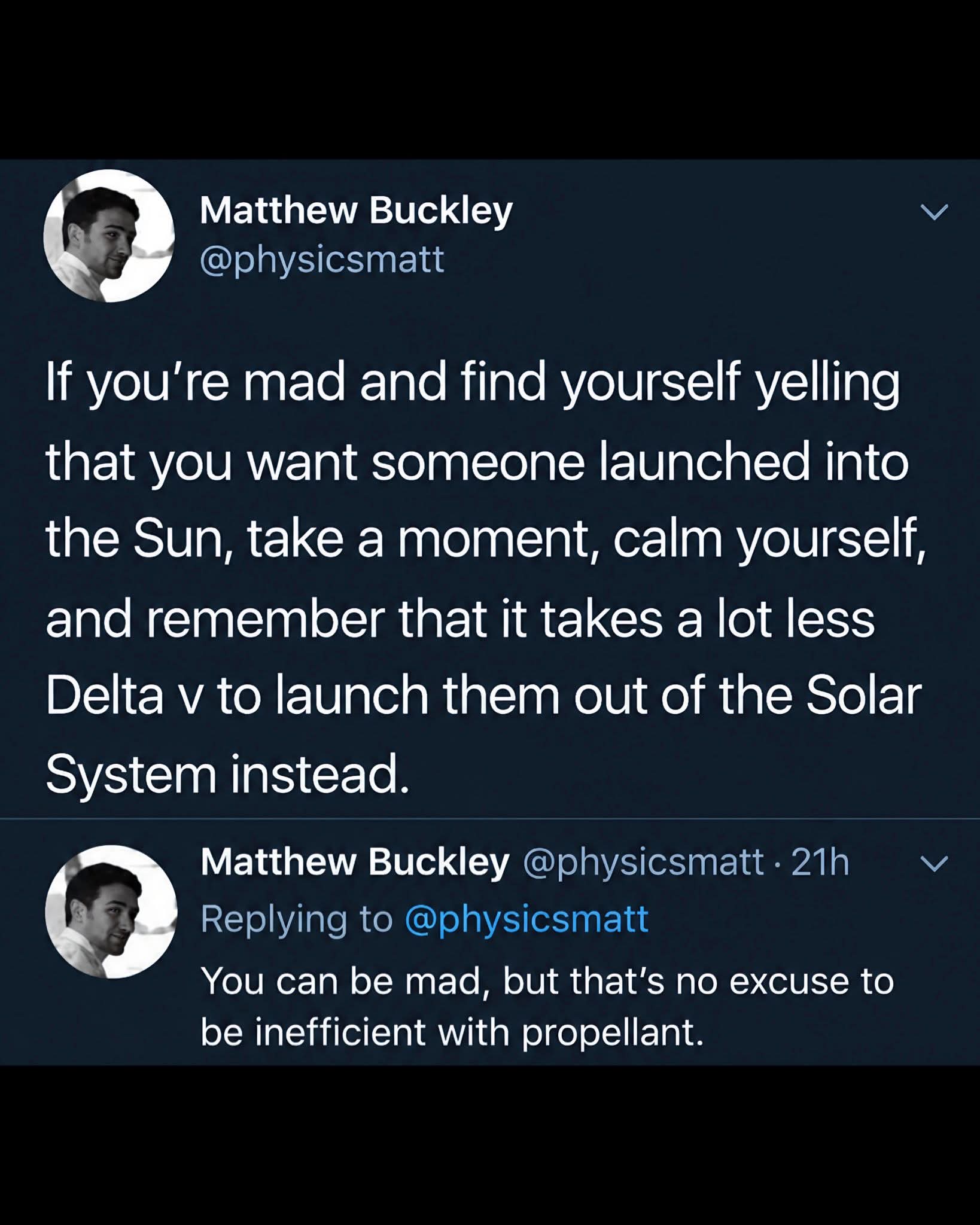
If you want to prove a point: Trebuchet them into active volcanoes. It uses no propellant, very little effort, and gets the point across.
If you want to be efficient: Grind them up and use their corpse-meal as compost. Spread them in a field, grow hemp and/or soybeans.
deleted by creator
^ This guy efficients.
Yeah I’m not risking them coming back later with an alien army
I need you to understand that when I want someone launched into the sun, it’s not because it is easy, but because it is hard. I want to go to the extra effort and delta v necessary so that we can make it abundantly clear that you, evil horrible cretin, are worth the collective effort of thousands to personally be launched into the sun.
Ok, JFK, calm down.
I get that it’s very difficult to send something directly into the Sun. Couldn’t you just put them into a highly eccentric and unstable orbit that would crash into the sun after several passes?
frankly, yeeting them 50m into the air is enough to give them a bad day.
Can someone explain why it’s easier to yeet something out of the solar system, than to yeet something into a massive gravity well?
My dumbass thanks you in advance
Orbital speeds. Remember earth and by consequence everything on it is moving at 30km/s. Most efficient way to hit the sun is to cancel that out, or decelerating until your velocity relative to the sun is 0 and then gravity does the rest of the work. Orbiting a stellar object is missing with flair. It’s easier to entirely miss the sun by accelerating at roughly 12 Km/s additional velocity which will allow you to escape the sun’s gravity. Or 40% of the delta V (more velocity is not linear fuel expended either, more exponential with needing roughly 99x more fuel to do one than the other… not even accounting for the chase of now accelerating that fuel weight.)
Just download Kerbal Space Program and it’ll all become clear. It’s a blast and accidentally teaching you orbital mechanics.
Make sure to buy the original in that case.
Do NOT buy Ksp2. That game is a very unfinished early access game which has been conpletely abandoned, and it’s shameful that it’s still listed in the Steam store.
We’re technically falling towards the Sun.
We don’t hit it, because we’re also moving around it at a crazy speed.
So even though we’re falling, we permanently miss it. If that makes sense.
The change in speed (deceleration) it would take to slow us down enough that we fall directly towards and into the Sun… is greater than the change in speed required to go fast enough to fly away from it.
So, you need energy to either change your velocity by 30km/s, or by 12km/s.
Hence, easier to speed up a ‘little bit’ more.
Right now you are flying, together with earth more or less the speed you need to stay orbiting the sun forever.
Add a “little” speed and you fly away
A soccer player needs to either score a goal, which would be hitting the sun. Or they need to knock it out of bounds, which would be sending out of the solar system.
Both require power to drive the vehicle, but only one needs accuracy.
more like, you need to hit a goal at the bottom of a funnel-shaped pit, but you’re in a car driving in circles on the walls of the funnel at 100mph, and anything going 150 mph shoots out of the top of the funnel. aim isn’t the problem, the shape of the funnel will take care of that. the issue is to get to the bottom you have to kick the ball backward hard enough to cancel out the speed of the car, i.e. 100mph, whereas to launch out of the pit, you only have to kick the ball forward at 50mph. if you kick backwards at 50mph, the ball will just keep circling the pit at 50mph; it might eventually reach the bottom but it will take a long time
Operative word is “into” the sun. Hitting the sun specifically = harder vs the general “away” direction.
I suppose we could sent them to a Lagrange point and call it good?
I’d be satisfied with a sub-orbital parabola in the general direction of *gestures at sky*
Someone on the other end might need a mop but ¯\_(ツ)_/¯
I’m assume the reason why is because, in order to go into the sun, 100% of Earth’s rotational velocity has to be counteracted, and it doesn’t for the opposite direction?
What about launching them into Venus? It’s smaller, and closer. Would that save on gas?
~I think I got three-fitty in my center console.~
So we can’t just do the same thing that we do to get something out of the solar system, but “in reverse”? Like a reverse/inverted slingshot? Use the inner planets to brake?
Or how about this, do a slingshot maneuver, but only a single one, that launches it softly straight outwards from one of the planets, in line with the sun. Then just wait until it loses momentum and starts falling straight into the sun. Would that take too long, maybe?
Like if we just dropped something into existence at 1 AU from the sun without any orbital momentum, how long would that object take to fall into the sun?
It’s surprisingly difficult to launch anything out of the solar system due to orbits and the Oort Cloud. Not saying the sun is easy, but in my opinion, it’s definitely more realistic.
But I want to picture them burning not freezing or running out of oxygen.
Source for the claim?
Looks like the source is a screenshot from a microblog. Hope that helps 🤗