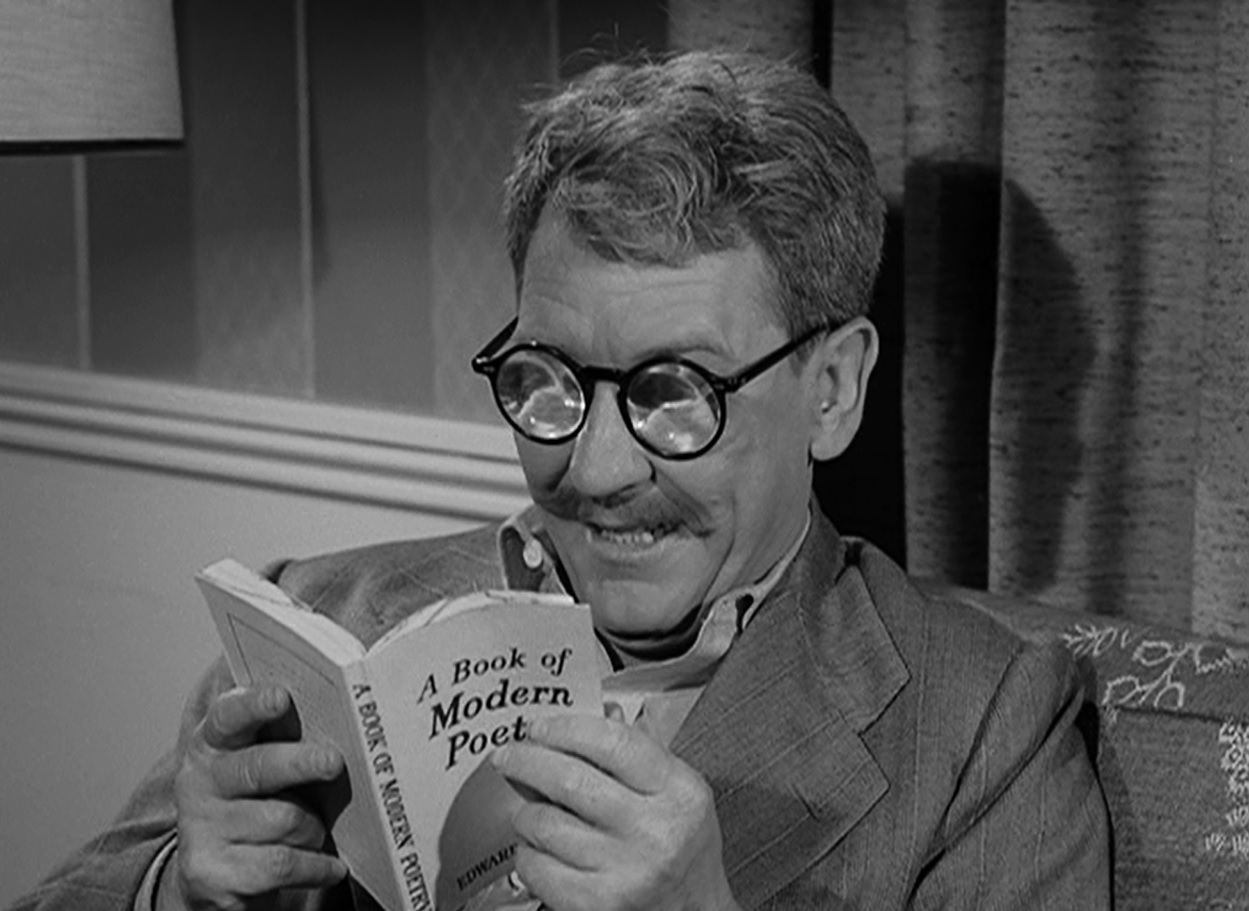
In the Second Scroll of Wen the Eternally Surprised, a story is written concerning one day when the apprentice Clodpool, in a rebellious mood, approached Wen and spake thusly:
“Master, what is the difference between a humanistic, monastic system of belief in which wisdom in sought by means of an apparently nonsensical system of questions and answers, and a lot of mystic gibberish made up on the spur of the moment?”
Wen considered this for some time, and at last said: “A fish!”
And Clodpool went away, satisfied.
I love how, even never having read this before, I know it’s Terry Pratchett
Here’s a legit Zen koan that fits the bill:
Mumonkan number 14: Nansen kills the cat
Once the monks of the Western and Eastern Halls were arguing about a cat. Nansen, holding up the cat, said, “You monks! If you can say a word of Zen, I will spare the cat. Otherwise I will kill it.” No one could answer, so Nansen cut the cat in two. That evening, when Joshu returned, Nansen told him of the incident. Joshu thereupon took off his sandal, put it on his head, and walked off. Nansen said, “If you had been there, the cat would have been saved!”
an interpretation
It might make more sense if you replace Joshu’s actions with “doing a jerk-off motion.” He’s treating the discussion as unserious, as well as treating himself as unserious.
Nansen shows up looking to start an argument in bad faith, no doubt with all sorts of rhetorical talking points prepared designed to catch the other side in a gotcha. Attempting to engage just takes you into his prepared talking points and responses, while evading the question or refusing to answer makes him feel like he’s “won,” and leaves his words unchallenged.
The only thing you can really do is to take him off script and take the wind out of his sails. Nansen was prepared for the possibility that they’d answer, and prepared for the possibility that they’d refuse to engage, but he didn’t have a plan for what to do if someone put a shoe on their head.
Also, by treating himself unseriously and humbling himself, Joshu removes Nansen’s motivation to prove his superiority and the superiority of his house. Joshu essentially “shows his belly,” and says through his actions, “Bro, I’m just a silly little guy, if you wanna kill that cat, that’s all you.” Nansen’s internal justification for killing the cat could only be that he wanted to knock the other side down off their high horse, and so by abandoning any sense of dignity he would remove that motivation, and the cat’s life would be saved.
By both having the wisdom to understand Nansen’s thought process, and having the humility to put aside his dignity for the sake of saving the life of an innocent being, Joshu ironically displays a better grasp of Buddhist teachings than Nansen, regardless of whether Nansen could beat him in a debate through wordplay and rhetoric.
Neat :) thanks for that
I am enlightened!
Rhetoric is like Excel, it can make anything look sensible.
Those koans were stories written by Mumon. They weren’t all based entirely on real events. Maybe Nansen gave a dharma talk where he said he would kill the cat, but to actually kill it would go against the precepts. Highly doubtful that actually happened.
The point of the koan isn’t surface level though, and if you expect to be able to extract a lesson from a koan by one simple reading, then you’re approaching koans wrong to begin with.
Mumon’s commentaries might help guide your understanding, and perhaps secondary scholarship like a translator’s notes or whatever. But unless you’re viewing it from inside the tradition, it’s likely to seem obscure/perplexing.
But unless you already understand what he means by “say a word of Zen,” and why Joshu placing a sandal on his head was taken as an acceptable answer, then this story will elude you no matter how you look at it.
A Buddhist monk walks up to a hot dog stand and says “Make me one with everything.”
Koans are designed to be given by a teacher to a student when the teacher personally assesses that the student could benefit from considering it. They’re also designed to not be comprehensible rationally or immediately, but rather to prompt introspection and to get someone to reflect on their own thought patterns. You can’t just rip them out of that context while not understanding the belief system and treat them like a riddle from Reader’s Digest and expect to get anything out of them.
I admire your knowledge of Buddhist theory.
But this is a shit post community so it’s as unserious as the most zen person in the world.
Meanwhile, the silliest zen practitioner:

Bonus:

Buddha did say you could put whatever you want on your pizza, even if he himself didn’t like it, which is pretty fucking based as far as religions go.
Buddha never had someone order durian pizza for the group.
The most Zen thing would be to eat it all up, every bite, and say nothing since obviously durian pizza for the group would be intended to get a rise from them. You accept the adversity, and learn never to let that guy order pizza for the group ever again.
Durian pizza is quite popular in China, people buy it unironically.
I also tried Durian coffee. I could still taste it 4 hours later.
Flavored coffee is a crime.
How is the pizza? I love me some Gorgonzola on one, so I can see the appeal of some funk.
I didn’t try the pizza, pizza in asia is almost always disappointing.
I can understand if someone doesn’t like coffee and just wants a flavored milk drink with coffee undertones.
Why are all buddhist stories like this?
Anon has apparently never read a buddhist story
You (self) will never achieve nirvana (enlightenment) unless your Buddhist (eastern religion) stories have a bunch of untranslated Sanskrit (language) words in them that the translator (language expert) was too lazy (high on their own farts) to translate (explain). So every Buddhist buddhavacana (text) reads like this
Honestly if I’m reading a translation, I’d rather read “sunyata” than “emptiness,” rather read “skandhas” than “aggregates,” rather read “prajna” than “wisdom”, etc…
“Emptiness” has a range of meanings in English that distract from what’s indicated by “sunyata.” A cup is empty after I drink it. Lacking any permanent/inherent/essential nature is sunyata.
“Aggregate” is what you put in concrete to give the cement something to bind to. “Skandhas” are the aspects of identity that we tend to conflate as an essential self-image; i.e. body, sensation, perception, cognition, and awareness (now be grateful I didn’t say rupa, vedana, samjna, samskara, and vijnana).
“Prajna” is a direct insight into the nature of reality that defies verbal explanation. “Wisdom” is a loaded term with many possibile meanings, including the unsolicited advice that your older family members get upset when you promptly ignore, the inane tautologies that a preacher spoon-feeds his unquestioning flock every Sunday, or even the snakepit of discursive reasoning that’s come to be known as “philosophy” in the west. Prajna is none of those things, and the closest any of them come is probably when Plato says true philosophers are derided as cloud-gazers.
So you see, when translators choose to preserve a Sanskrit or a Pali word, it’s not them being lazy. It’s them deciding that English (or the language they’re translating to) doesn’t have an equivalent concept, and that it’s better for the reader to learn a new word with its full range of associations, rather than try to squeeze so many layers of meaning into an existing English word that is already loaded with pre-conceived notions.
I know it is a shitpost but I think the goal is sometimes to force a student to move away from thought.
Anti-intellectualism? On 4chan???
Those who know do not speak; those who speak do not know
Unless you can master your anger, your anger will become your master
I just have 2 verses in my personal book of Philosophy and Words to Live By.
Verse 1: If you think you understand what’s going on, you haven’t been paying attention.
Verse 2: There is no situation that is so bad that it can’t get worse. And it’s about to get worse.
Reminds me of the kind of thing you’d read in a Douglas Adams book.
Life is a Douglas Adams book.
You’d think I’d be able to spout off some good quote off the top of my head because ive read the guide probably 12 times, but I just can’t. Maybe something about the cricket wars?
That’s OK so long as you can feel the rules in your bones.
Scientist theorize that if we knew why the
bowl of petuniaspiles of shit thought this, we’d have a better understanding of the universe.
My preferred version of verse two is: There isn’t anything you can’t blow up twice.
My verse 2 stems from when I was a medic back in the day, and we got paged for a “don’t feel so good” call. We got there and the patient was visually not in the best shape. I decided we were upgrading the call to a “swoop and scoop” to hit the road to the hospital with little delay.
We were lifting that patient out of her recliner and turning her enough to sit her down on the cot when she literally died right then and there. Which of course got the patient another upgrade from the “swoop and scoop” to “Oh shit! Oh shit! We gotta go! We gotta go now!” which also adds the “Inject ALL the diesel!” upgrade for the driver.
A quick check found no pulse or respirations. So I started CPR and my partner grabbed the 12 lead to get the big pads if we needed to shock and placed the pads. I did 2 rounds of CPR and we hit the analyze button. Which said no shock. And a quick check of the patient’s vitals showed everything was working again. If in a bit of a sketchy fashion.
We got loaded and roared off in a cloud of diesel smoke and made the 20 mile trip to the hospital with little delay and no worsening of the patient’s condition. After radioing in to the hospital with a patient report, the patient was met with all hands on deck at the door when we arrived.
I heard the patient died about 2 months later in a nursing home. One of the perks of working rural EMS where you work on family and friends.
And thus, rule #2 was born.
I was gifted a book called “Pointing at the Moon” that was filled with these things. Stuff like "A student was asked by a master, “what was you’re face before you were born? The student walked to a river, saw his face reflected in the water, and was enlightened.” Like wtf is that supposed to mean? Lol.
I didn’t even understand the title of the book until I saw this meme.

If you immediately know the candlelight is fire, the meal was cooked a long time ago
Everyone here is wrong and the gum on your shoe is a rock on your Lake. If you look at it.
‘Then buddha detonates 20 old people’
Zen buddhism kōans are intentionally incomprehensible https://www.youtube.com/watch?v=9p5Oi4wPVVo
Australian Buddhism is much easier to understand
- don’t be a cunt
- see #1
alas, not many practitioners.
Chat is this real? Which Buddhist stories are like this?